

Introduction
The prevalence of childhood mortality in third world countries is very high. In Africa and South Asia alone, it accounts for 90% of the world total1. A previous study in Nigeria2 showed an overall childhood mortality of 11.6%. In the majority of developed countries, the mortality among children is estimated to be 0.02 per 1000 childhood population3. Most African countries record an all-cause childhood mortality of around 26.5%4 with diseases such as malaria and HIV (AIDS) predominating.
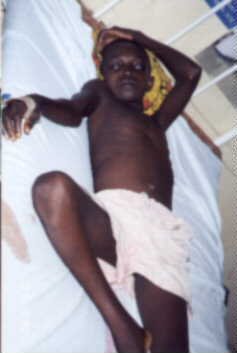
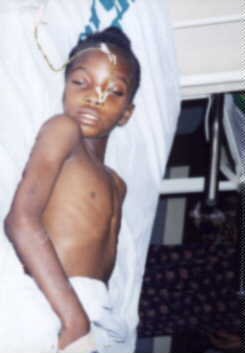
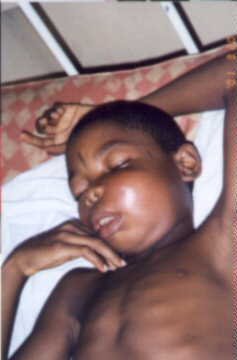
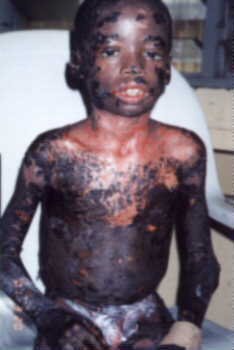
The following study was undertaken to ascertain the all-cause mortality among children in the urban city of Port Harcourt.
PATIENTS AND METHODS
This study took place at the University of Port Harcourt Teaching Hospital a tertiary institution which serves a population of 10 million.
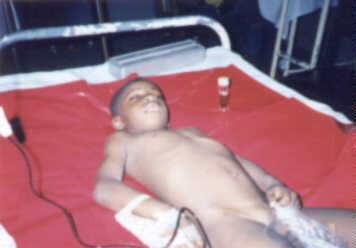
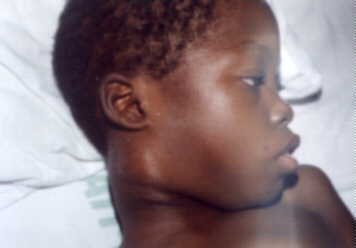
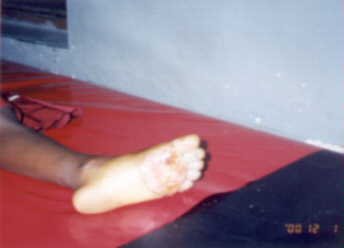
From January to December 2000, photographs of severely ill children admitted into the Children's wards and Children's emergency rooms were taken with the parents' consent. The case notes of all admitted children were assembled for analysis at the end of the study period. Data extracted from the case notes included name, hospital number, age, sex, address, date of admission, investigations, diagnosis on admission, treatment, date of death, diagnosis at death, and post mortem findings. The various causes of death were expressed as the percentage of the total number of deaths.
RESULTS
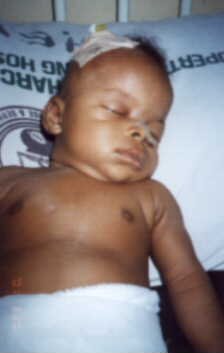
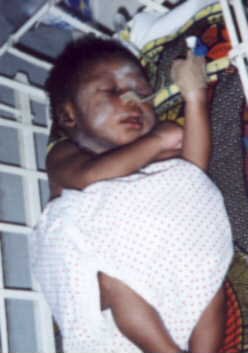
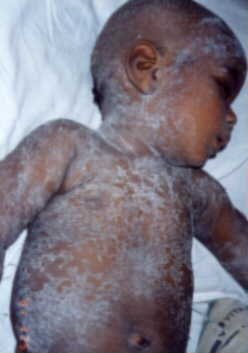
Figures 1 to 11 are photographs of severely ill children admitted within the study period.
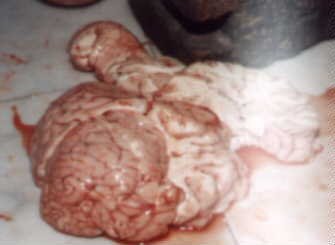
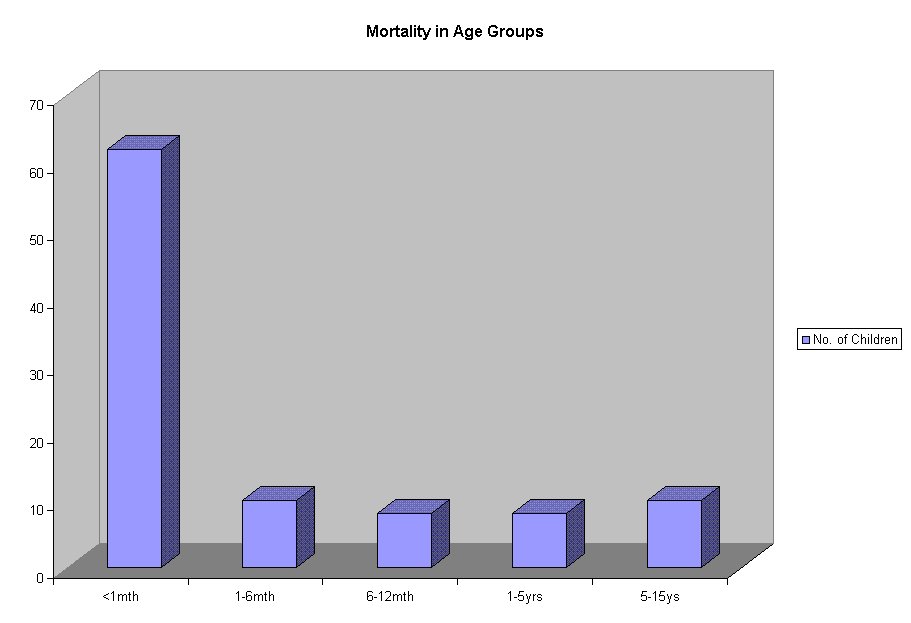
There were 98 deaths (5.1%) out of a total of 1777 admissions between January to December 2000. The male to female ratio was 1:1.04. Table 1 outlines the various causes of death. The largest single cause was birth asphyxia (20.4%) followed by malaria(10.2%),anemia (10.2%),and tetanus(9.2%). The age range was 1day-16yrs,(mean 5.3yrs). Neonates predominated accounting for 62 deaths (63.3%), (Figure 12). A post mortem was done in only one child and the final diagnosis was leukemia.
| CAUSES OF DEATH | TOTAL NUMBER | NUMBER % |
|---|---|---|
| BIRTH ASPHXIA | 20 | 20.4 |
| MALARIA | 10 | 10.2 |
| ANAEMIA | 10 | 10.2 |
| TETANUS | 9 | 9.1 |
| NEONATAL JAUNDICE | 7 | 7.1 |
| PREMATURITY | 6 | 6.1 |
| MENINGITIS | 6 | 6.1 |
| PNEUMONIA | 5 | 5.1 |
| ACUTE RENAL FAILURE | 4 | 4.0 |
| SEPTICAEMIA | 4 | 4.0 |
| CONGENITAL ABNORMALITIES | 3 | 3.0 |
| GASTROENTERITIS | 3 | 3.0 |
| TUBERCULOSIS | 2 | 2.0 |
| RHEUMATIC HEART DISEASE | 1 | 1.0 |
| BURKITT'S LYMPHOMA | 1 | 1.0 |
| STEVEN JOHNSON SYNDROME | 1 | 1.0 |
| EPILEPSY | 1 | 1.0 |
| HIV/AIDS | 1 | 1.0 |
| HIRSCHPRUNG'S | 1 | 1.0 |
| MECONIUM ASPIRATION | 1 | 1.0 |
| LEUKAEMIA | 1 | 1.0 |
| BURNS | 1 | 1.0 |
| TOTAL | 98 | 99.8 |
DISCUSSION
Port Harcourt, one of the fastest developing cities in the country is the capital of the Rivers State which is considered one of the richest Oil Producing States in Nigeria. An estimated 40% of the population are aged 0-16 years.
This study shows a mortality rate of 5.1% which is much higher than the 0.02 per 1000 children seen in developed countries3 but comparatively lower than that of 11.6% recorded in Ilorin - western Nigeria2. It is also much lower than a community based study done in Kenya which showed an all cause mortality rate of 26.5%4. In Ghana, another community based study recorded a rate of 23.9% per one thousand children per year5. These mortality rates in under developed countries remain unacceptably high. The discrepancies in the two Nigerian studies may reflect better facilities in the health care delivery system since 1987 when the earlier study was done. It may also indicate a better standard of living in this oil rich city compared to the middle belt of Nigeria which is considered less wealthy.
The commonest causes of death were birth asphyxia (20.4%), malaria (10.2%), anemia(10.2%), and tetanus (9.2%). These are preventable. Our findings contrast sharply with the commonest causes of admissions and deaths in developed countries. A study done in Nottingham, UK showed that the commonest presenting problems to an accident and emergency department in a children's hospital were trauma or surgical (69%) as opposed to medical (27%)6. In the United States of America the major causes of death in infancy and childhood are congenital heart defects, whose mortality rate has decreased to 0.02 per 1000 population3. In Holland there is an increased mortality risk in children with epilepsy (0.5 per 1000 children) compared with the general population of children7.
There was no death from trauma in this study. This was a surprise finding. The explanation is unclear. It is however possible that most childhood deaths from road traffic accidents occur at the site of the accident and the victims do not therefore reach the hospital.
The prevalence rates and deaths from tetanus remain disturbing. In 1990, an immunization coverage of 95% was achieved in Nigeria with the help of UNICEF and Nigerian Federal Ministry of Health. This has fallen to 40%8. Factors contributing to the low immunization coverage include ignorance, low literacy rate, poverty and poor accessibility to Health Centers by the majority of the population who live around the creeks and islands of the delta basin area of the Rivers State9.
Pediatric HIV/AIDS infections accounted for only 1% of deaths in this study. There is an increased number of pediatric HIV (AIDS) cases in Nigeria in recent times10. Most of the cases abscond as soon as the diagnosis is made because of the associated social taboo coupled with a lack of anti retroviral drugs whose prices are not within the reach of most Nigerians. Another factor in the low prevalence of HIV/AIDS in this study is the fact that serology for HIV is not done routinely and even when indicated relations who have to pay for the test find it too expensive. It is therefore likely that the contribution of HIV/AIDS to the mortality rate in this study is underestimated.
Harmful practices such as burning a child to abort a febrile convulsion or forcing a child to drink cow's urine11 or other concoctions whose chemistry is unknown, still abound. Specific educative programmes should be targeted at these.
Post mortem examination was performed in only one child. There is a worrying dearth of post mortem examinations in this institution and in other parts of Nigeria12. Parents refuse post mortem examinations as being a waste of time. This is similar to findings in Zambia and other parts of Africa13.
In summary, although the percentage deaths on admission among children in Nigeria is less than it was over a decade ago, it remains high. The majority of the causes of death are preventable. Efforts to further reduce the mortality should be directed at prevention and early treatment.
References
- Costello A White H. Reducing global inequalities in child health. Archives of Disease in Childhood 2001; 84:98-102 ↑
- Fagbule D and Joiner KT. Pattern of Childhood Mortality at the University of Ilorin Teaching Hospital. Nigerian Journal of Pediatrics 1987; 14: 1-5. ↑
- Boneva R S, Botto LD, Moore CA, Yang Q, Correa A, Erickson JD. Mortality associated with congenital heart defects in the United States: trends and racial disparities, 1979-1997. Circulation 2001;103:2376-81. ↑
- McElroy PD, Kuile FO ter, Hightower AW, Hawly WA, Phillipshoward PA, Oloo AJ, Lal AA, Nahlen BL. All-cause mortality among young children in western Kenya VI: the Asembo Bay Cohort Project. American Journal of Tropical Medicine and Hygiene 2001; 64(1-2 Suppl): 18. ↑
- Allotey P, Reidpath D. International Programs, Key Centre for Women's Health, Faculty of Medicine and Density. Social and Scientific Medicine 2001; 52: 1007-12 ↑
- Armon K, Stephen T, Gabriel V, Macfaul R, Eccletus P, Werneke U, Smith S,2001 Determining the common medical presenting problems to an accident and emergency department. Archives of Disease in Childhood 2001; 84:390-392 ↑
- Callenbach PM, Westendorp RG, Geerts AT, Arts WF, Peeters EA, Van, Donselaar CA, Peters AC, Stroink H, Brouwer OF. Mortality risk in children with epilepsy: the dutch study of epilepsy in childhood. Pediatrics 2001;107: 1259-63. ↑
- UNICEF. The progress of nations. UNICEF 1998 ↑
- Ogunbekun IO Financing medical care in Nigeria: Whither social insurance? Nigerian Medical Practitioner 1990;19:63-65 ↑
- Bello CSS, Mawak JD, Otubu JAM. Human Immunodeficiency virus (HIV) and treponema pallidum infections in mothers and their babies at delivery in Jos. Tropical Journal of Obstetrics and Gynaecology 1997; 14: 46-50 ↑
- Ayorinde F O, Avery JW, Adekile AD, Ojewole JA, Odebiyi OO. Chemistry of a Nigerian Herbal Preparation (Cow's Urine Concoction). Journal of Tropical Pediatrics 1982; 28:235-239 ↑
- Onuigbo MAC. Acute renal failure in south-eastern Nigeria : A twenty-four months prospective analysis ↑
- Lishimpi K, Chintu C, Lucas S, Mudenda V, Kaluwaji J, Story A, Maswahu D, Bhat G, Nunn AJ, Zumla A. Necropsies in African children: consent dilemmas for parents and guardians. Archives of Disease in Childhood 2001; 84:463-467 ↑