
ACKNOWLEDGEMENTS
This research has been the best and the most challenging experience for me, truly because it got me closer to kind people whom I would have never been associated with otherwise. Here I take this opportunity to thank each and every person without whom this piece of research would have never been possible.
My gratitude and special thanks, to my supervisor, Dr. Margaret Cox for her constant encouragement, support and generous advice throughout my research.
Thanks to Dr. Satheesan, for volunteering to come on site with me and giving his valuable expertise in ornithology specializing as a vulture expert, assisting me while carrying out the research and providing me the required information at all times.
Thanks a lot to Angela Whitworth for her endless support and helpful suggestion during the writing process of this dissertation. Thanks to Penny Dale for helping me with the sources for my literature. Thanks also to Dr. Martin Hall and Dr. Mark Maltby for imparting their valuable suggestions. Also thanks to Ian Hanson for his encouragement and suggestions.
I would sincerely like to thank Mr. Naresh Singh Gautam and his family in Lucknow, Uttar Pradesh who supported and helped me throughout my stay in Lucknow.
Thanks to Mr. Ramesh Pandey, Divisional Forest Officer of Katerniaghat Wildlife Sanctuary for the security and Mr. Mohammad Ahsan, Chief Wildlife Warden for providing me the required permissions to conduct the experiment.
Thanks to Mr. Khan, the Chief Engineer and Mr. Sharma, the Assistant Engineer from Girija Barrage Flood Control Unit, for allowing me to use the facilities at their guest house. Thanks to Mr. Riyaz Zaheer for helping me with the information about District Bahraich.
Thanks to Dr. Asad Rahmani from Bombay Natural History Museum and Dr. S A Gaikwad from Bombay Veterinary College for permitting me the use of specimens in the laboratory.
My deepest thanks to Vijay Kumar and his family for providing the field, for experiment at Site A, and for assisting me with the requirements at site B at all times throughout the field research. Thanks also go to the Chief of the Gram Panchayat, Dr. Suresh Kumar and the locals from both the villages for their support.
A special thanks to my entire team in Uttar Pradesh without whom the field exercise would not have been easy. Thanks to:
Mr. Amit Kumar Gupta for the photography
Mr. Sunil Kumar for the Video recording
Mr. Pappu Singh for his safe driving
Workers at Girija Barrage Flood Control Unit
Maujiram, Faudey, Baburam, Girja Kumar, Kishore
I would also like to thank my employers, Roger Kaye, Gill Kaye and Lyn Grant, and my workmates at the Wessex Muse Magazine for their patience and support during this research.
And above all my eternal thanks to Sajjad Qadir, for his confidence in me and giving me the invariable support throughout, to make this challenging experience come true!
In an observational taphonomic study, recording was undertaken by means of written notes, still photography and film footage. An animal carcass (goat {Capra hircus}) was exposed in a humid environment within a semi-forest area, in north-eastern India, in an effort to explore the effects of avian and other scavenging on the carcass and its subsequent distribution. The incidental location of a larger carcass (buffalo {Bubalus bubalis}) nearby and the impact of this upon scavenger behaviour resulted in the focus of the study shifting to the larger carcass.
Results indicated that within this geographical location, a combination of avian (White-backed vultures {Pseudogyps bengalensis}, Egyptian vultures {Neophron percnopterus} and Jungle crow {Corvus macrorhynchos}), mammalian (Feral dogs {Canis familiaris} and Common foxes {Vulpes vulpes}) and reptilian (Crocodiles {Crocodylus palustrius}) species scavenged the carcass which was skeletonised in seven days. Avian scavengers preceded the terrestrial scavengers in locating the carcass with the larger avian species not remaining involved once the reptilian species engaged. This almost certainly reflects their inability to move quickly. The various types of scavengers were con-specific with respect to carrion feeding. Most of the types of scavengers participated during the active decay stage in the decomposition process of the carcass. Disarticulation and scattering of the remains occurred in a predictable anatomical sequence of the skeletal remains, (i.e. making certain group of bones being transported together). The extent of the scatter was minimal.
Of considerable importance, there is no published research showing crocodiles to be scavengers yet this was observed during this study. This research highlighted their opportunistic behaviour. Observation also suggested that the rate of consumption of the carcass by the crocodiles increased in the absence of any insect activity though this may be incidental.
This study was undertaken to inform forensic responses to searches for missing persons in such an area and it has highlighted the requirement for having an understanding of scavenging behaviour of the various actors, i.e. recognizing the modifications to scenes of crime and human remains for accurate crime scene interpretation. Further work is recommended, including analysis and comparative study of the lesions on some of the skeletal elements that were retrieved from the site, most of which reflect various teeth marks and possible impacts of beaks and claws.
| CONTENTS |
| Page No. | |||||||
| Title page | i | ||||||
| Acknowledgements | ii | ||||||
| Abstract | iv | ||||||
| Contents | v | ||||||
| List of Tables | x | ||||||
| List of Figures | xii | ||||||
| Page No. | |||||||
| Chapter 1: INTRODUCTION | 1 | ||||||
| 1.0. | Introduction | 1 | |||||
| 1.1. | Structure of this dissertation | 2 | |||||
| 1.2. | Aim and objectives | 3 | |||||
| 1.3. | Background to the study | 3 | |||||
| 1.3.1. | Religious funerary “sky burial” practices | 3 | |||||
| 1.3.2. | Violent crimes affecting life in Uttar Pradesh | 8 | |||||
| 1.4 | Professional significance to the study | 8 | |||||
| 1.4.1. | Forensic archaeology | 9 | |||||
| 1.4.2. | Forensic anthropology | 10 | |||||
| Chapter 2: LITERATURE REVIEW | 11 | ||||||
| 2.0. | Introduction | 11 | |||||
| 2.1. | Methods used in literature review | 12 | |||||
| 2.2. | Types of scavengers and their behaviour | 13 | |||||
| Page No. | |||||||
| 2.3. | Avian scavenging behaviour | 14 | |||||
| 2.3.1. | Morphological changes | 14 | |||||
| 2.3.2. | Disarticulation and scattering | 15 | |||||
| 2.3.3. | Post-mortem artefacts and scavenging trauma | 16 | |||||
| 2.4. | Mammalian scavenging behaviour | 17 | |||||
| 2.4.1. | Morphological changes | 17 | |||||
| 2.4.2. | Disarticulation and scattering | 18 | |||||
| 2.4.3. | Post-mortem artefacts and scavenging trauma | 20 | |||||
| 2.5. | Reptilian scavenging behaviour | 21 | |||||
| 2.5.1. | Morphological changes | 21 | |||||
| 2.5.2. | Disarticulation and scattering | 22 | |||||
| 2.5.3. | Post-mortem artefacts and scavenging trauma | 22 | |||||
| 2.6. | Insect activity | 23 | |||||
| Chapter 3: MATERIALS AND METHODS | 24 | ||||||
| 3.0. | Introduction | 24 | |||||
| 3.1. | Geographical context of the sites | 24 | |||||
| 3.2. | Location | 24 | |||||
| 3.3. | The climate | 27 | |||||
| 3.4. | Soil | 27 | |||||
| 3.5. | Flora and fauna | 28 | |||||
| 3.6. | Risk assessment | 28 | |||||
| 3.7. | Study area | 29 | |||||
| 3.7.1 | Site A | 29 | |||||
| 3.7.2 | Site B | 30 | |||||
| 3.8. | Specimen | 30 | |||||
| 3.8.1. | Goat | 31 | |||||
| Page No. | |||||||
| 3.8.2. | The Asian Water Buffalo | 31 | |||||
| 3.9. | Methodology | 32 | |||||
| 3.9.1. | Setup | 32 | |||||
| 3.9.2. | Study period | 35 | |||||
| 3.10. | Recording | 35 | |||||
| 3.10.1. | Weather recording | 35 | |||||
| 3.10.2. | Observational recording | 36 | |||||
| 3.10.3. | Photographic recording | 37 | |||||
| 3.10.4. | Video recording | 37 | |||||
| Chapter 4: RESULTS | 38 | ||||||
| 4.0. | Introduction | 38 | |||||
| 4.1. | Quality assessment | 38 | |||||
| 4.2. | Assessment of actors observed at site A | 40 | |||||
| 4.3. | Assessment of actors observed at site B | 41 | |||||
| 4.4. | Assessment of relative timing of scavenging by the actors | 43 | |||||
| 4.4.1. | Date factor | 43 | |||||
| 4.4.2. | Time factor | 46 | |||||
| 4.4.3. | Decomposition | 47 | |||||
| 4.5. | Anatomical sequence of scavenging | 50 | |||||
| 4.6. | Scatter pattern | 53 | |||||
| 4.7. | Presence of trauma | 56 | |||||
| 4.8. | Weather | 57 | |||||
| 4.8.1. | Temperature | 57 | |||||
| 4.8.2. | Humidity | 58 | |||||
| 4.8.3. | Rainfall | 60 | |||||
| Page No. | |||||||
| Chapter 5: DISCUSSION AND CONSLUSIONS | 62 | ||||||
| 5.0. | Introduction | 62 | |||||
| 5.1. | Approach to the carcass by the actors | 62 | |||||
| 5.1.1. | Discussion | 62 | |||||
| 5.1.2. | Conclusion | 63 | |||||
| 5.2. | Relationship between actors with respect to mutual carrion feeding | 63 | |||||
| 5.2.1. | Discussion | 63 | |||||
| 5.2.2. | Conclusion | 64 | |||||
| 5.3. | Stages of decomposition and approaches by the actors | 64 | |||||
| 5.3.1. | Discussion | 64 | |||||
| 5.3.2. | Conclusion | 66 | |||||
| 5.4. | Anatomical sequence and scatter pattern | 66 | |||||
| 5.4.1. | Discussion | 66 | |||||
| 5.4.2. | Conclusion | 68 | |||||
| 5.5. | Weather | 68 | |||||
| 5.5.1. | Discussion | 68 | |||||
| 5.5.2. | Conclusion | 70 | |||||
| 5.6. | Overall Conclusion | 70 | |||||
| 5.7. | Limitations | 72 | |||||
| 5.8. | Further work | 73 | |||||
| BIBLIOGRAPHY | 75 | ||||||
| APPENDICES | Page No. 87 |
||||||
| Appendix 1 | : | Search strategy sources | 88 | ||||
| Appendix 2 | : | Exclusion and inclusion criteria | 89 | ||||
| Appendix 3 | : | Definitions of research design | 91 | ||||
| Appendix 4 | : | The quality appraisal questions | 92 | ||||
| Appendix 5 | : | Vulture nesting sites in Katerniaghat Wildlife Sanctuary | 94 | ||||
| Appendix 6 | : | Permission for research from the Chief Wildlife Warden, Uttar Pradesh | 95 | ||||
| Appendix 7 | : | Risk assessment | 96 | ||||
| Appendix 8 | : | Articles included in the literature review provided with study number and study type | 98 | ||||
| Appendix 9 | : | Responses to quality appraisal questions | 104 | ||||
| Appendix 10 | : | Description of the actors observed at site over the seven day study period | 106 | ||||
| Appendix 11 | : | Number of approaches by individual actor at different times of the day over the seven day study period | 112 | ||||
| Appendix 12 | : | Daily decomposition changes | 115 | ||||
| LIST OF TABLES |
| Page No. | |||
| Table 2.1 | : | Research designs identified in published materials presented in order of scientific ranking | 13 |
| Table 2.2 | : | An overview of species and the preferred part(s) of the body targeted | 18 |
| Table 2.3 | : | An overview of species and the trauma caused on remains | 20 |
| Table 4.1 | : | Concise report of search articles based on their scientific ranking of the research design | 38 |
| Table 4.2 | : | Result of Quality Assessment | 39 |
| Table 4.3 | : | Summary of the actors and the number of times seen approaching the carcass during the seven day study period | 41 |
| Table 4.4 | : | Summary of observation / recording | 43 |
| Table 4.5 | : | Daily approaches by each actor to the carcass over the study period | 44 |
| Table 4.6 | : | Total number of approaches at different times of the day by the actors over the seven day study period | 46 |
| Table 4.7 | : | Approach by each species to the carcass at the various stages of decomposition including the insect activity | 48 |
| Page No. | |||
| Table 4.8 | : | Number of approaches by each species during the different stages of decomposition | 49 |
| Table 4.9 | : | Number of approaches by the different types of actors observed, at various stages of decomposition | 49 |
| Table 4.10 | : | Preferences of the actors to certain anatomical elements / parts and the accessibility | 51 |
| Table 4.11 | : | Scatter pattern by each actor by the seventh day of the study and the day it occurred | 54 |
| Table 4.12 | : | Daily temperature and average daily temperature in Celsius during the seven day study. | 57 |
| Table 4.13 | : | Daily humidity recorded at 0700 hours, 1200 hours and 2000 hours and average daily figures. | 59 |
| Table 4.14 | : | Daily recorded rainfall in mm during the seven day study period | 60 |
| LIST OF FIGURES |
| Page No. | |||
| Figure 1.1. | Corpse-bearers carrying the corpse of a Parsee inside the Tower of Silence | 4 | |
| Figure 1.2. | Illustration of a Tower of Silence | 5 | |
| Figure 2.1. | Illustration of the most frequently observed articulating anatomical components from a human skeleton to be scavenged | 19 | |
| Figure 3.1. | Site in Uttar Pradesh State in India | 25 | |
| Figure 3.2. | Map of Bahraich District in Uttar Pradesh State | 26 | |
| Figure 3.3. | Location of site in Bahraich District | 27 | |
| Figure 3.4. | Site A | 29 | |
| Figure 3.5. | Site B | 30 | |
| Figure 3.6. | Goat carcass at site A | 31 | |
| Figure 3.7. | The Asian water buffalo carcass | 32 | |
| Figure 3.8. | Cordoned area at site A | 33 | |
| Figure 3.9. | Sandy-clay road at site B | 34 | |
| Page No. | |||
| Figure 4.1. | Condition of the goat carcass after two hours of being exposed | 40 | |
| Figure 4.2. | Actors and the total number of approaches by each species to the carcass, observed during the seven day period | 42 | |
| Figure 4.3. | Population of each species observed during the seven day study period | 42 | |
| Figure 4.4. | Daily approaches by each actor to the carcass during the seven day study period | 44 | |
| Figure 4.5. | Daily cumulative approach by all the actors observed during the seven day study period. | 45 | |
| Figure 4.6. | Daily approaches by the different types of species observed during the seven day study period | 45 | |
| Figure 4.7. | Number of approaches at different times of the day by the actors over the study period | 47 | |
| Figure 4.8. | Bloat stage of the buffalo carcass on 18th August 2005 | 48 | |
| Figure 4.9. | Illustration of daily approaches by the actors with reference to decomposition stages and insect activity | 50 | |
| Figure 4.10. | Lateral view of the skeleton of a buffalo carcass | 52 | |
| Figure 4.11. | Parts of abdominal cavity of buffalo | 53 | |
| Figure 4.12. | Showing grids within the cordoned area | 54 | |
| Figure 4.13. | Relative scatter pattern of the remains by the seventh day of the study period | 55 | |
| Page No. | |||
| Figure 4.14. | Arrow indicates anomaly | 56 | |
| Figure 4.15 | A Comparison of daily average temperature and the cumulative approach by all the actors over the seven day period | 58 | |
| Figure 4.16. | Comparison of daily humidity and the cumulative approach by the actors over the seven day period | 59 | |
| Figure 4.17. | Comparison of daily rainfall and the cumulative approach by the actors over the seven day period | 61 |
| CHAPTER 1 – INTRODUCTION |
1.0. Introduction
Avian are often the first scavengers on the scene of shallow burials or surface deposits (France et al., 1992). In light of this it is perhaps surprising that there is a paucity of information and literature with regards to avian scavenging (Haglund, 1996) especially of the impact of vultures. The prime concern of the perpetrator after committing a murder is usually disposing of body and in turn the evidence. One of the ramifications of disposal according to the least effort principle is surface disposal, (Killam, 1990) and may be in an area roosted by vultures, as it may be assumed that vultures will erase all evidence through its voluminous, speedy and thorough scavenging. Confusion relating to the cause or manner of death or dispersion of a corpse may arise and thereby all of the evidence. A flock of vultures, i.e. 200 – 300 vultures (Satheesan, 1998), are capable of rapid and complete defleshing of a recently killed animal and can strip the soft tissue from a dead body in a few hours (Morse et al., 1983).
This observational case study, set in northern India, attempts to understand the role of scavenging by avian species with special focus on vultures, and other faunal scavengers upon decomposing human cadaver utilising a surrogate animal carcass. With its evidentiary recording, this dissertation will enlighten some of the aspects of the nature of scavenging, scattering, trauma to the bones and the time taken to completely de-flesh the animal carcass by avian and various faunal scavengers, during the rainy season in the semi forested area of one North-eastern part of India.
The experimental site was selected as it is known to be a haven for vultures, with five extant species namely, White-backed Vultures, Egyptian Vultures, Indian long-billed Vultures, Redhead and Griffons, even at a time of near extinction of these scavengers in other parts of the world. It is expected that this research may assist other forensic experts to make their decisions when encountered with human remains from similar environments.
Hereafter all the avian and faunal scavengers will be called as “actors” (Loe et al., 2005, p13) for concise reference.
1.1. Structure of this dissertation
Chapter one, defines the aims and objectives, provides the background to the study and explores the rationale for carrying out this research with respect to forensic archaeology and forensic anthropology. Within the background it introduces the origin of idea for the dissertation including the religious funerary “sky burial” practices and the criminal investigations involving avian scavenging. It further provides the status of violent crimes in the state of Uttar Pradesh. Chapter two, focuses on the peer reviewed published materials, assessing its scientific and intellectual credibility and value, on scavenging behaviour of various actors. As the approach to this review was carried out systematically it was relevant to include it in this chapter. The review emphasised on understanding the commonalities portrayed by these actors during scavenging. This chapter also included entomology in brief. Chapter three, explains in detail the materials and methodology used in this observational study. It includes the description of the study area, risk assessment for, the alterations of site and specimen, and the recording carried out during the study period. Chapter four presents the results of the quality assessment for the literature review and the outcomes of the field observations as they occurred at the study area. The presentation of the results in this chapter is in compliance with the aim and objectives. Chapter five incorporates the discussions and conclusions of the results obtained during the study. In addition it also highlights the limitations to this study and recommendations that could be undertaken for further work.
1.2. Aims and objectives
In an observational study, to survey the role of actors in the taphonomic processes of a decomposing human cadaver, using surrogate animal carcasses in the buffer zone of Katerniaghat Wildlife Sanctuary – District Bahraich, Uttar Pradesh, India.
To carry out a literature review in a systematic way and to apply quality assessment criteria to the literature identified.
To assess which scavengers are involved.
To assess the relative timing of scavenging by the various actors on the carcass.
To assess if there is a preferred anatomical sequence to scavenging by the various actors.
To assess the resulting scatter pattern and over what distance.
To assess the time taken to completely de-flesh the carcass.
A superficial assessment to establish the presence or absence of trauma that may have been inflicted upon the skeletal elements of the carcass by the actors concerned.
1.3. Background to the study
The background to the study includes the origin of the idea for the dissertation, exploring the local religious funerary practices and their geographical extent and the violent crime statistics in Uttar Pradesh State in India.
1.3.1. Religious funerary “sky burial” practices
Disposing the dead by exposing them for excarnation is a funerary practice of the Zoroastrian community in India, the Parsees. They believe that vultures were created to devour corpses and that this form of disposal, limits the defiling of the earth; air; and water; that are sacred to the Parsees (Pain et al., 2003). Parsees practice a form of sky-burial in which the dead are carried by the corpse-bearers and placed on top of a sacred structure called a “Tower of Silence” (Modi, 1922), (see Figure 1.1).
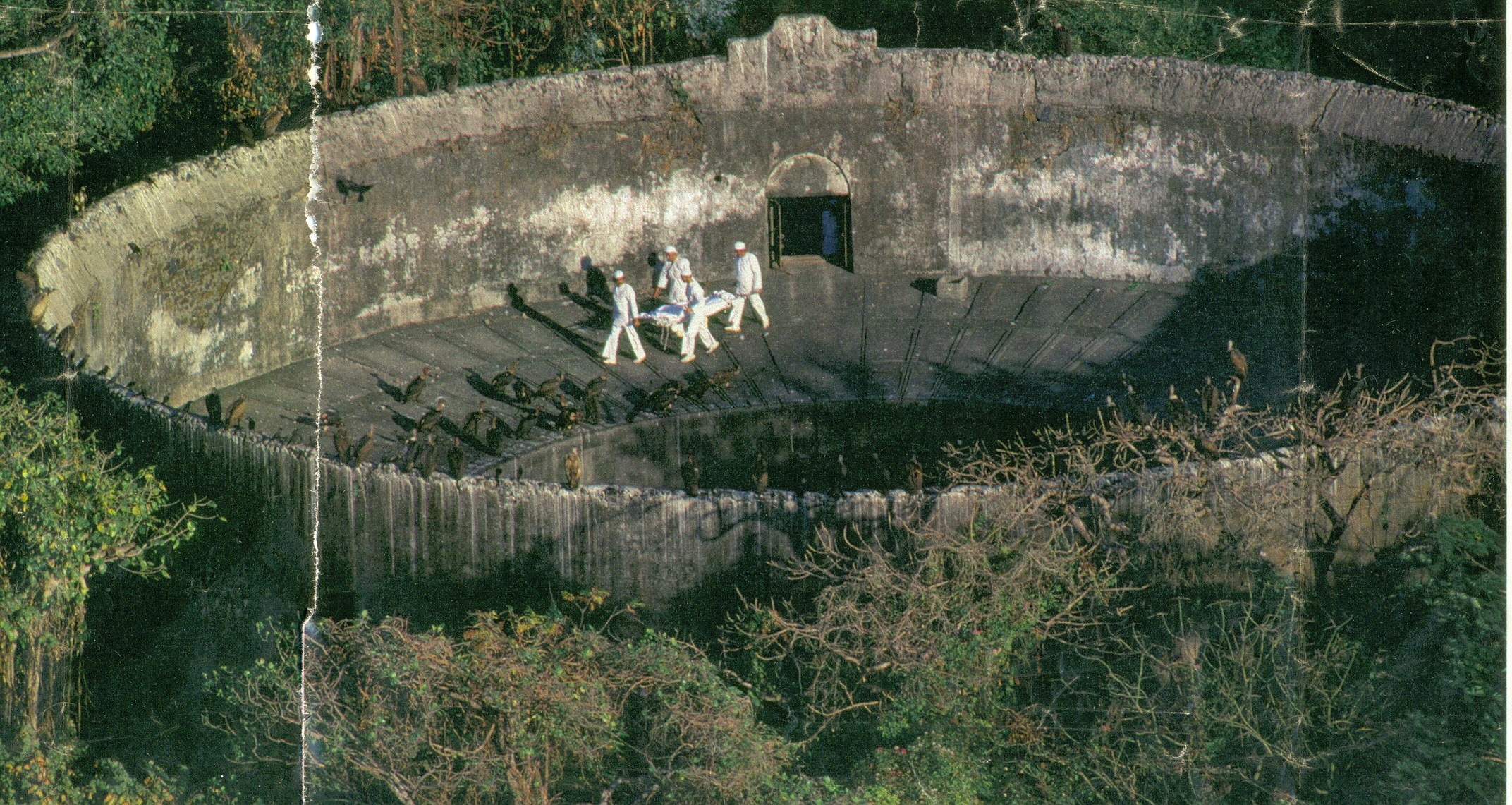 |
| Figure 1.1: Showing a corpse being carried by the corpse-bearers inside the Tower of Silence in Bombay (Daily Telegraph Magazine, 2005). |
This is a round enclosed structure of some thirty six metres high (Modi, 1922) built throughout of solid stone, (see Figure 1.2). The entrance is from its east through an iron gate which opens to a circular platform leading to a central circular well.
The circular platform of some ninety one metres in circumference (Modi, 1922) is entirely paved with large stone slabs and is divided into three circular rows of shallow open receptacle that appear like three-tiered, open arenas (Mistry, 1991), (see Figure 1.2). Immediately after death, the body is washed with water and wrapped in white cloth (Modi, 1922). The corpse bearers, dressed in white (see Figure 1.1), take the corpse to the Tower during daylight1 (Modi, 1922). The corpse of men are placed in the outer circle, women in the middle circle and children in the innermost circle, for the vultures to feed on. The deep central well, paved with stone slabs, of some forty five metres in circumference (ibid) is used for depositing the dry bones.
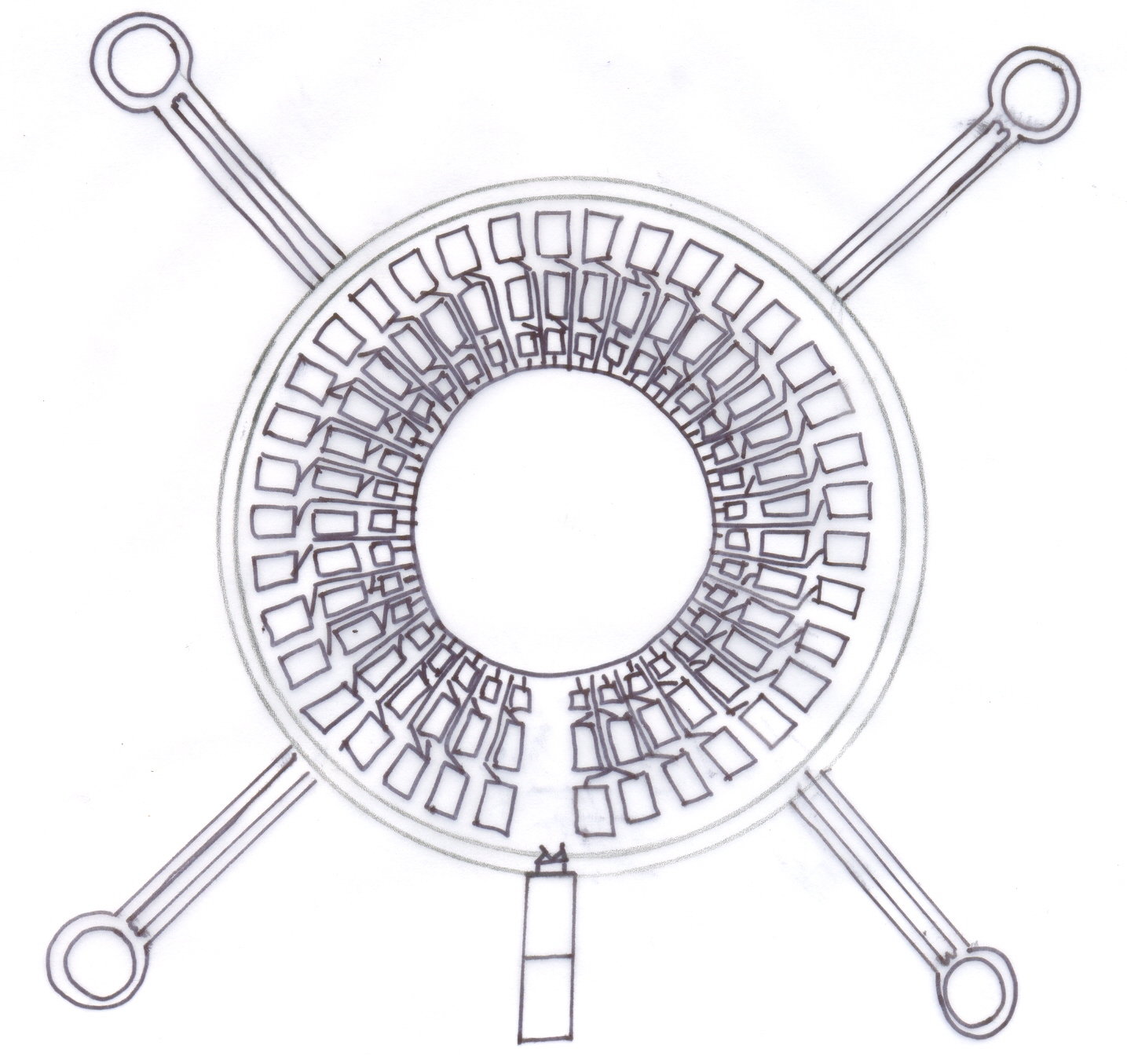
7 4 8 3 9 5 10 2 1 6 N |
||
| Key | ||
| 1 | - | Entrance stairs |
| 2 | - | Entrance Iron gate |
| 3 | - | Boundary wall (approximately thirty six metres high) |
| 4 | - | Underground drain |
| 5 | - | Underground well for drain |
| 6 | - | Central Well (approximately forty five metres in circumference) |
| 7 | - | Circular platform ( approximately ninety one metres circumference) |
| 8 | - | Platform for the corpse of men (outer circle) |
| 9 | - | Platform for the corpse of women (middle circle) |
| 10 | - | Platform for the corpse of children (innermost circle) |
| Figure 1.2: Illustration of a Tower of Silence (adapted from Modi, 1922) (Not to scale) | ||
The corpse is completely stripped of its flesh by about 100 - 120 vultures (Satheesan et al., 1990) within an hour or two, and the bones of the denuded skeleton, when perfectly dried up are placed in the well, where they are reduced to dust. There are holes in the inner sides of the well through which the rain water is carried into four underground drains that are each connected to four underground wells. This keeps the corpses comparatively drier during the rains. This form of burial reflects their basic belief that neither the living nor the earth should be contaminated by the dead but remain pure (Joel, 2005). There are Parsees in Iran, Iraq, and India, still holding on to this ancient belief, and to the westerner, their burial ceremonies are quite extraordinary (Mistry, 1991).
A similar death ritual is practiced by Tibetans who believe that sky-burial transports the spirit of the dead safely to heaven (Niema, 1980). Excarnation sites or charnel grounds are usually located near monasteries. Drigung Monastery is located on a steep hill in the Meldor Gungkar county of Central Tibet (Logan, 1997). After death, the corpse is cleaned and wrapped in white cloth, positioned in a foetal arrangement, the same position in which the person had been born (ibid). A ‘body-cutter’ dressed in long white aprons unwraps the corpse, which is naked, stiff, and swollen (Niema, 1980). Men hold huge cleavers, which are in a few strokes whetted to razor sharpness on nearby rocks and rip open the body of the deceased. Within a few minutes the dead man's organs are removed and set aside for later, separate disposal.
The cutters give a signal calling the vultures and the flock rushes in, covering the body completely, their heads disappearing as they bend down to tear away flesh (Logan, 1997). The vultures are enormous birds with virtually featherless head, so as not to impede the bird when reaching into a body to feed. Men pull out what remains of the corpse which is usually only a blood stained skeleton and pound the bones reducing them to splinters. This is mixed with barley flour and then thrown to the waiting crows and hawks. Remaining vultures grab slabs of softened gristle and greedily devour them. Within half an hour, the body has almost completely disappeared and what remains of the skeleton is abandoned at the burial site (Logan, 1997).
In light of the known effectiveness of vultures in the destruction of a human corpse, their potential value to a perpetrator of murder is immense. Consequently, this study aims to begin to understand what impact such birds and other potential actors may have in a natural (i.e. non-funerary ritual) context. There are twenty-three species of vultures. Of these, some are to be found in almost every continent except for Antarctica and Australia (Mundy et al., 1992). They are generally well known for their scavenging efficiency, the speed and volume of flesh devoured and their ability to reduce the corpse to skeleton (Satheesan, pers. comm., 2005).
Consequently, they also provide perpetrators of murder with an efficient mechanism of disposing of the dead and erasing all evidence in a matter of 20 minutes to an hour if a good congregation of vultures feed on the corpse (Satheesan, pers. comm., 2005). An example of this is that of a serial killer, Herbert Mullin, who in 1972-1973 was a 24-year old religious, former scholar-athlete at Santa Cruz high school. He suffered some form of mental illness after the death of his best friend in a motorcycle accident in 1965. He beat two people to death with a baseball bat, ripping the organs from one victim with his bare hands, and leaving the pieces for the vultures (Lane et al., 1992).
The impact of vultures on the remains of victims of atrocity crimes is also known. During one of the investigations carried out by, Physicians for Human Rights, PHR in Northern Afghanistan (Physicians for Human Rights, 2002) for the collection of preliminary information of mass gravesites. The authors reported that the remains were being removed from a very shallow surface grave by vultures, thereby erasing and / or disturbing evidences (ibid).
The idea for this dissertation was sown by these cases, because it is important to understand the forensic ramifications of avian scavenging.
1.3.2
Violent crimes affecting life in Uttar Pradesh
The National Crime Records Bureau2 (NCRB) categorized violent crimes into four groups3 (Ministry of Home Affairs, 2003). Violent crimes affecting life is the first group and covers all cases associated with; murder; attempt to commit murder; culpable homicide not amounting to murder; dowry deaths; and kidnapping and abduction (ibid).
The Ministry of Home Affairs publication ‘Crime in India – 2003’ presented the most up-to-date reports by the NCRB showing 32,716 total incidences of murder registered under the Indian Penal Code (Ministry of Home Affairs, 2003). The highest incidents, i.e. 5,284, of murder, accounting for 16.2% of total cases were reported alone from Uttar Pradesh State. Of these, firearm was used as the murder weapon in 3,855 cases accounting to 72.95%.
During 2003, out of the total 33,656 unidentified dead bodies that were recovered at all India level, Uttar Pradesh reported 4,327 cases (Ministry of Home Affairs, 2003). These cases may also consist of the victims that were murdered using firearms in the State. Such cases need the association of criminal investigators to resolve the conditions surrounding the murder. However, due to the poor social infrastructure, corruption and bureaucracy no information was available about the conditions in which these bodies were recovered to aid in reconstruction.
If it may be assumed that the remains of these unidentified murdered victims, killed by using firearm, were found in areas colonized by avian and faunal scavengers then difficulty may arise in search, location, recovery and interpretation of the crime scene without the knowledge of avian and faunal scavenging behaviour.
1.4. Professional significance of the study
Death may be related to accidents, homicide and suicide or may be from natural causes (Solla et al., 2003). Whatever the case, where it may be relevant the source, of the trauma must be sought. The interest of any forensic investigation, such as, homicide, missing person, genocide, war crimes or any natural disaster, such as earthquakes, tsunami, etc., lies in reconstructing the events surrounding the fatality (Iscan et al., 2000). Hence any clues obtained at the scene of crime or site would be beneficial in the investigations.
Understanding the role of the actors in the taphonomic process of decomposition of human cadavers and linking them for forensic purpose will enable forensic archaeologists, forensic pathologists and forensic anthropologists to make quick decisions and accelerate the investigative process (Bass, 1997).
Understanding trauma is one of the aspects of a scientific investigation (Ubelakar, 1991). There may be clear signs, such as stab wounds, blunt force injury, ligatures from hanging or a bullet wound (Iscan et al., 2000). In order that any anthropogenic marks may be distinguished from those inflicted by the actors, as they may be responsible for the post-mortem morphology, distribution and preservation of skeletal remains (Krogman et al., 1986), a general awareness of artefactual post-mortem animal and bird activity may avoid their misinterpretation (Tsokos et al., 1999).
1.4.1. Forensic archaeology
Challenges facing a forensic archaeologist lie in: locating the deposited human remains, either shallow / deep burials, or surface scatters; maximizing their recovery; assessing spatial relationships of evidence of the crime, including the cause of death, burial or dispersal; differentiating ante, peri, post mortem movement and modification sequences; and interpreting information from the scene context (Bevan, 1991). Identification of the nature of crime, torture and abuse leading to successful conviction, is based on an integrated knowledge of scientific approaches. The role of archaeology in forensic death investigation has focused on search, location, excavation techniques and documentation of context. Skills being: identification of surface anomalies; stratiagraphy (Harris, 1989); knowledge of soils; collection and conservation of artefacts; along with special areas of interest, such as taphonomy (Haglund, 2001).
The scatter pattern due to vulture scavenging, if known to the forensic archaeologist, may assist in using appropriate techniques to search, locate and recover the human remains in areas with vulture populations.
1.4.2. Forensic anthropology
When human remains are found in an advanced stage of putrefaction, burned, or skeletonized a forensic anthropologist uses metric and non-metric traits and characteristics to evaluate such bones, in an attempt to establish: the minimum number of individuals; sex; stature; age; ethnicity; health; and trauma (Nawrocki, 1996b). If the effect on bone of the trauma inflicted by the beaks of vultures during scavenging is known to the forensic anthropologist, it will allow them to better understand the post-mortem taphonomic processes that have effected the skeletal remains and thereby, prevent misdiagnoses of peri-mortem trauma. Beak marks can potentially mimic sharp weapons.
The observational field study comprised of observation and evidentiary recording of actual events that occurred in an unpredictable sequence during the entire scavenging process of the buffalo carcass. The remaining chapters will fully detail the nature and extent of the research undertaken, and any results and conclusions drawn from this is clearly stated.
Notes
- Vultures are in the Tower during daylight only (Satheesan, pers. comm., 2005) ↑
- NCRB – National Crime Records Bureau in India is a branch of the National Police Commission that maintains the crime and criminal records of all police stations within district, state and national levels in the country. ↑
? Four groups: I) Violent crimes affecting life
II) Violent crimes affecting property
III) Violent crimes affecting public safety
IV) Violent crimes affecting women
↑
Download this chapter as the original Word document (2914 kb)