


Introduction
An artifact (British variant - artefact) is any artificial product; any structure or feature that is not natural, but has been altered by processing1. The term is used in histology and microscopy for a tissue that has been mechanically altered from its natural state. Any change caused or a feature introduced into a body after death that is likely to lead to misinterpretation of medico-legally significant ante-mortem findings is considered to be an artifact2.
In asphyxial deaths one of the signs of death can be the fluidity of blood because of increased release of fibrinolysins into the circulation3, whereas in the present case of hanging, the condition of intravascular blood being converted into a semi liquid pasty greyish material- a post-mortem artifact of blood with respect to its patho-physiology is discussed. Post-mortem artifacts are due to any change caused or feature introduced into the body after death. They are physiologically correlated to natural state of the body or tissues or the disease process to which a body was subjected prior to death. Ignorance or misinterpretation of such post-mortem artifacts can lead to:
a) wrong cause of death,
b) wrong manner of death,
c) undue suspicion of criminal offence,
d) a halt in the investigation of criminal death,
e) unnecessary spending of time and effort as a result of misleading findings or
f) miscarriage of justice4.
Every Forensic Pathologist must, therefore, be wary of missing out such crucial entities or he can really be in a "soup" of his own making!
Case Report
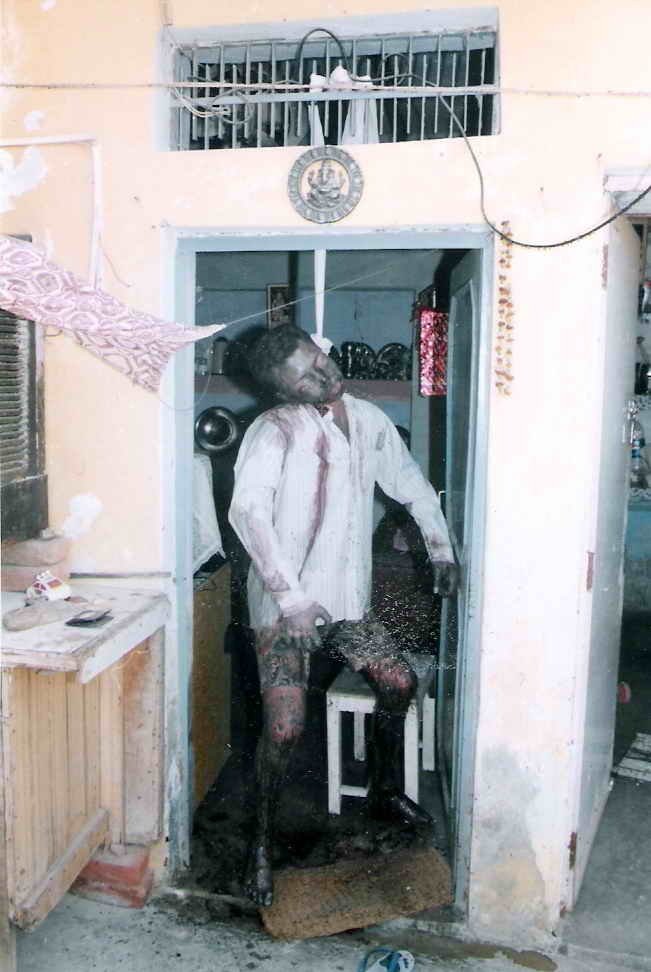
The dead body of a middle aged unemployed musician was brought to our department for post-mortem examination, being referred here by doctors from a district hospital. There was history that the man was found by labourers 2 days after he allegedly hung himself from a door hook in a room with the fan running in his house, when his wife was away to a nearby town. The body was found to be suspended fully from the door hook with both feet above the ground (photograph 1). The brothers of the deceased volunteered that relations between husband & wife were not cordial and this was his second marriage. The photographs from the scene of death showed a typical hanging scenario accompanied by an opened and tested/tasted bottle of alcohol. He had been without a job for over a year and was naturally depressed.
External findings of the body on autopsy
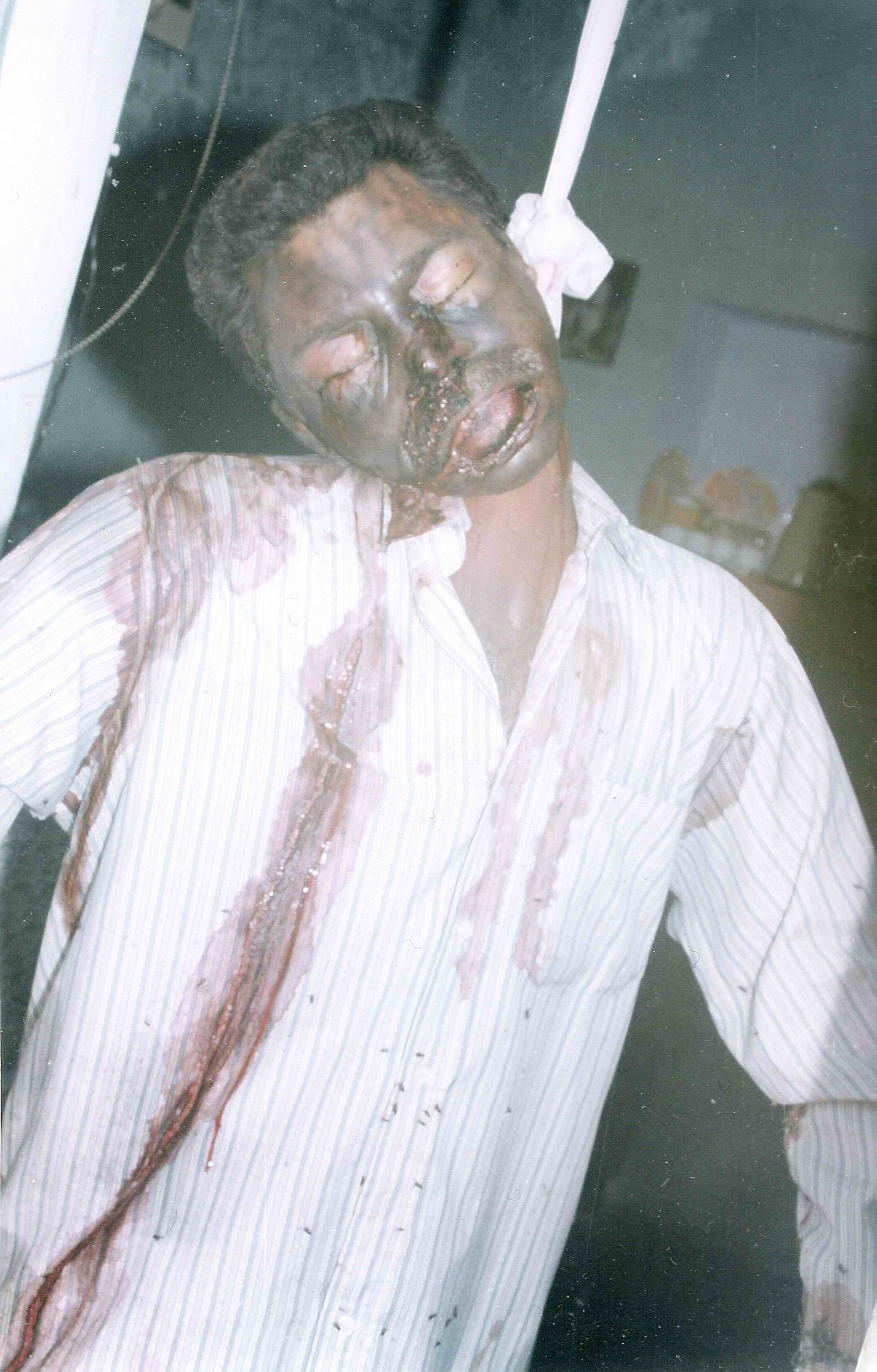
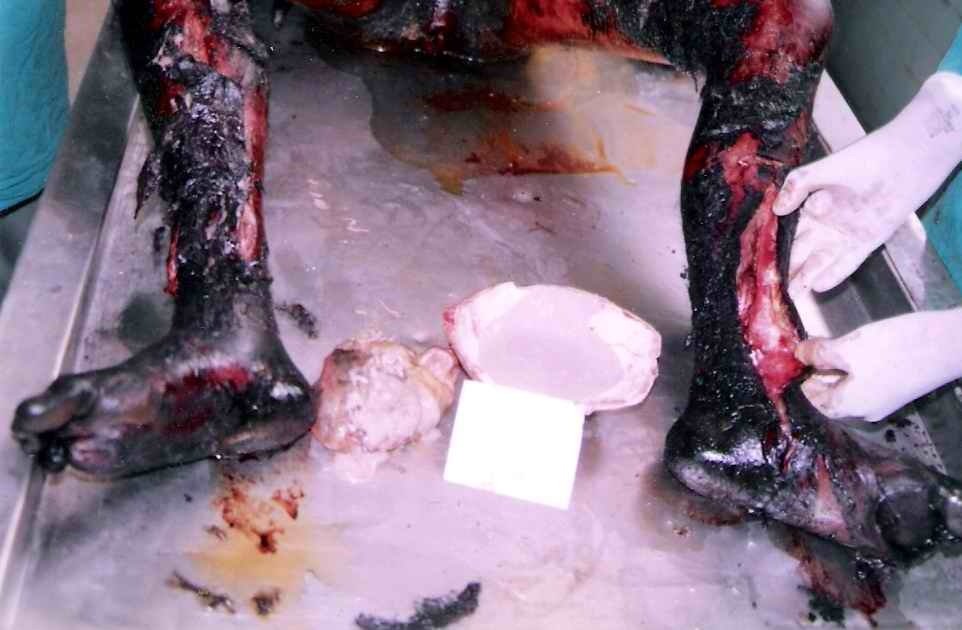
The clothes worn by the deceased were a full sleeved shirt and a Bermuda. The body was in an early stage of decomposition, it being the third day since the purported last date of being seen alive. There was a ligature material in the form of a nylon rope around the neck in a single ply with a sliding knot, placed high above the thyroid cartilage in oblique plane. The same was carefully removed and preserved. The ligature mark was that found in any typical case of hanging. Salivary stains were noticed in the form of dried, shiny trickles over the shirt worn by the deceased. Nothing was unusual on the first look; however there were dried clotted streaks of blood over the lower limbs (photograph 1,2).
Internal findings of the body
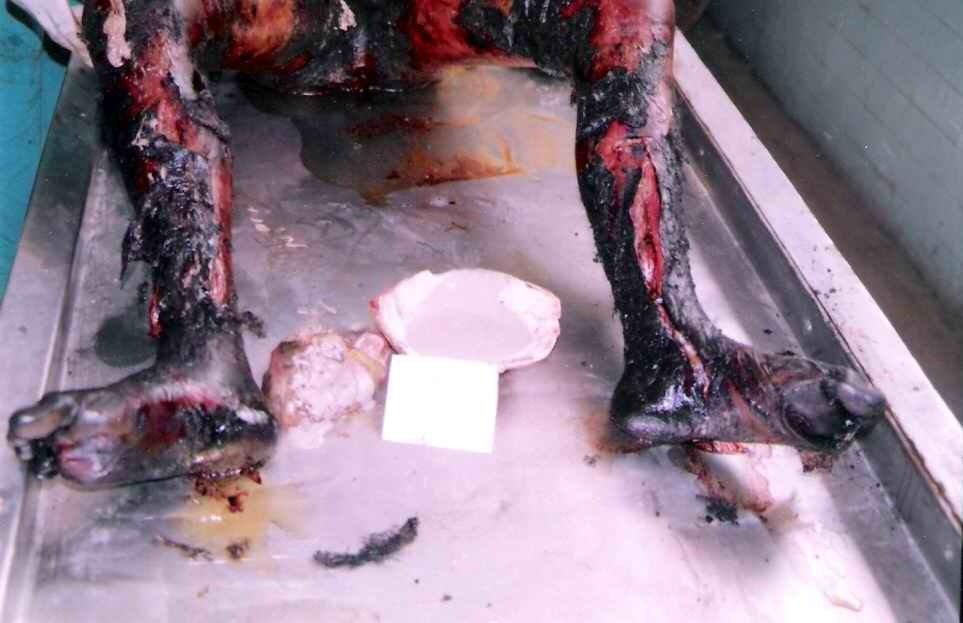
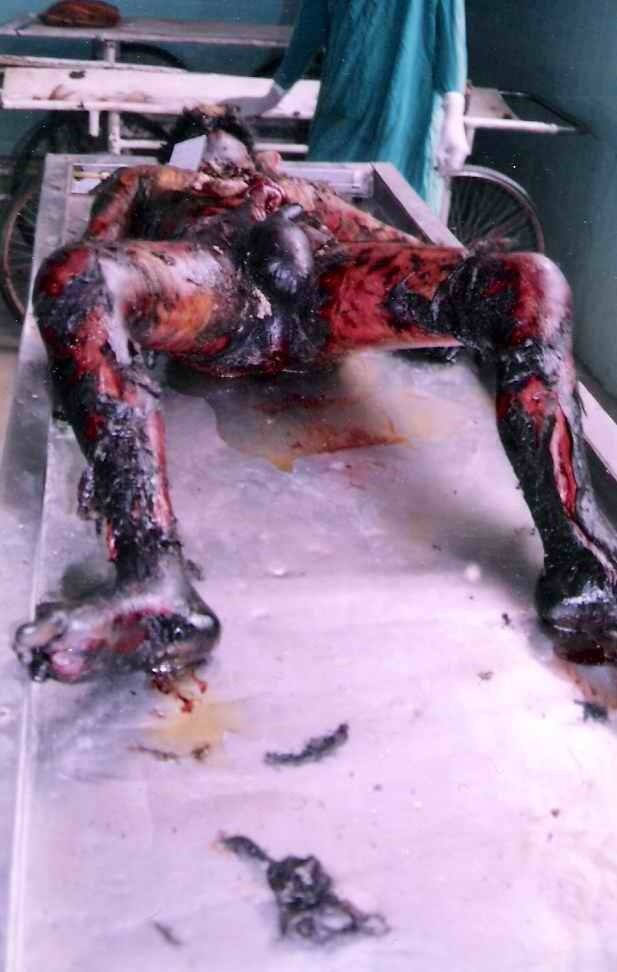
The internal findings in the neck were of ante-mortem hanging. While exposing deep neck structures, an artery was nicked and a gush of greyish semi-liquid material exuded. Similar material was discovered in the heart too. Surprised at not finding blood in the blood vessels in the neck, any connection between the neck vessels and the brain was checked for, as the content in the vessels resembled decomposed greyish brain matter. No such communication was found. The brain was greyish and paste like, a common finding of decomposition except that it was looking similar to the material found in the big vessels and heart (photograph 3,4), whereas the blood in the upper and lower limbs was reddish in colour and fluid in consistency. This material was collected for histo-pathological analysis. The blood in the lower body portion was reddish in colour (photograph 5).
Investigations
The histopathological analysis reported fibrin threads with enmeshed platelets and WBC intermingled in the plasma from the specimen of matter from the heart/vessels. Thus the constitution of the material turned out to be blood after all but in a very unusual form.
Conclusion and Discussion
To understand this strange phenomenon it is imperative to first discuss the normal composition of blood. Blood is composed of two components. Cellular elements comprising of RBCs, WBCs and platelets constitute some 45% of total blood volume. These are suspended in plasma - the second major component of blood. It constitutes about 55% of total circulating blood volume. Plasma consists of ions and inorganic and organic molecules. Plasma clots on standing. If the whole blood is allowed to clot and the clot is removed, the remaining fluid is called serum. Serum has same composition as plasma except its fibrinogen and some clotting factors have been removed5. Fibrinolysin (plasmin) is the active component of the plasminogen system. This enzyme lyses fibrin and fibrinogen with the production of fibrinogen degradation products that inhibit thrombin. Plasmin is formed from its inactive precursor, plasminogen by the action of thrombin and tissue type plasminogen activator6.
Forensic Taphonomy
Colour changes also accompany putrefaction. Aside from the purpling on dependent surfaces, livor mortis, there are colour changes due to at least two decompositional phenomena. These are (1) degradation of haemoglobin and conversion of heme to a series of bile pigments, and (2) formation of precipitates of H2S within vessels and tissues. Within a few hours after death, a greenish discolouration begins to spread over the anterior wall of the abdomen. Lysing pancreatic cells liberate a variety of hydrolases which attack biliary structures, releasing variously coloured pigments into the circulation and tissues of the abdomen. These are eventually visible in the overlying skin. These coloured pigments are produced principally within the liver as breakdown products of haemoglobin following digestion of worn out red blood cells, erythrocytes, by the spleen. The colours of the resulting bile pigments depend upon their oxidation state. At death, this reservoir of pigment is responsible for the initial colouration observed as biliverdin moves through the tissues. Some of the biliverdin, which is green, may be reduced to bilirubin which is red. However, within the increasingly acidic tissue environment, bilirubin is quickly reduced to urobilin which is brown. In superficial tissues where oxygen may be more available, some biliverdin is converted to blue and yellow pigments. In death, haemoglobin and other hemoprotiens, e.g. myoglobin, cytochrome, etc., may undergo degradation anywhere. Thus, heme breakdown eventually produces widespread pigment colouration effects in the body's tissues7.
What is already known on this topic
The fate of blood after death is well mentioned in the literature and in decomposed bodies it is hardly of any value except in poisoning cases. The forensic importance of blood lies in differentiating (i) ante-mortem from post-mortem blood, (ii) human from animal blood, (iii) arterial from venous blood, (iv) male and female blood, and so on. However, the condition of the blood in this present instance needs further exploration as such transformation is not mentioned anywhere in the available literature.
What This study adds
The observation made by the authors is reported for the first time which adds to the known list of artefacts of blood. Such artefacts should be looked into while conducting post-mortem examinations and should be considered as such by forensic pathologists and medical officers specially those working in the periphery.
Fate of post-mortem blood in hanging cases
Post-mortem artifacts are a common occurrence in all autopsies and if not accounted for with due care can lead to wrong interpretation of important findings and vice versa. Decomposition of the body is responsible for perhaps the most common and the most significant of the artifacts.8 Many a time, untrained and even very experienced autopsy surgeons come to wrong conclusions during post-mortem examinations. In hanging, blood will pool in the dependent areas of the body, usually the forearms, hands and lower legs, following the gravity. The fluidity of blood at autopsy depends on the rate of intravascular coagulation after death and concentration of fibrinolysin. When the fibrinolysin is active and the rate of coagulation is slow, the blood remains fluid and gravitates relatively rapidly into the dependent capillaries and veins over an extensive area. The red cells soon haemolyse and the escaped blood pigment diffuses out of the vessels into the surrounding tissues where it may undergo secondary changes. The capillary endothelium and the surrounding cells undergo lytic changes.9 Fluidity of blood due to absence of usual post-mortem clotting which is a constant feature in all types of asphyxial deaths may contribute to bleeding. Where putrefaction has set in, dark red brown and foul smelling fluid that resembles blood may run down the body. Such fluids originate from decomposing tissue and their presence does not constitute evidence of injury10. The red cells are the most affected, sedimenting through the lax network, but plasma also drifts downwards to a lesser extent causing an eventual post-mortem dependent oedema which contributes to skin blistering which is a part of early post-mortem decay11. The extent and the time of appearance of lividity mainly depend upon: (i) the volume of blood in circulation at the time of death, and (ii) the length of time that the blood remains fluid after death12.
Hypothesis proposed
With the above mentioned composition of blood, post-mortem degradation of its various constituents, microbial activity, effect of the gases of decomposition, autolysis and external factors like hot and humid currents in a hanged body where most of the blood gravitated downwards in the limbs, the remaining part of the blood in the upper part may be transformed into such a greyish pasty material. However, the exact mechanism for this transformation of intravascular blood into pasty greyish material is not mentioned in the available literature- this is the uniqueness of this artifact of blood which needs further exploration. The authors have not seen this phenomenon in any autopsy, hanging or otherwise before.
References
- 1. Dorland's Medical Dictionary. ↑
- Fateh Abdullah. Artifacts in forensic pathology. In: Handbook of Forensic Pathology. 1973; JB Lippincott Company Philadelphia: 235. ↑
- Simpson K (ed). Taylor's Principles and practice of medical jurisprudence, 12th Edition, 1965 (J & A Churchill Ltd, London) ↑
- Franklin CA Ed. In: Modi's textbook of Medical Jurisprudence & Toxicology. 21st Edition; NM Tripathi Bombay: 99. ↑
- Ganong WF. Circulating body fluids. In: Review of Medical Physiology. 20th Ed, 2001; McGraw Hill New York: 499-500. ↑
- Ganong WF. Circulating body fluids. In: Review of Medical Physiology. 20th Ed, 2001; McGraw Hill New York: 525-26. ↑
- Haglund WD, Sorg MH (Ed). Chemical & ultrastructural aspects of decomposition. In: Forensic Taphonomy: The postmortem fate of human remains. 1996; CRC Press Boca Raton: 101. ↑
- Fateh Abdullah. Artifacts in forensic pathology. In: Handbook of Forensic Pathology. 1973; JB Lippincott Company Philadelphia: 242. ↑
- Geberth VJ. In: Practical Homicide Investigation: Tactics, Procedures and Forensic techniques. CRC Press, Boca Raton; 1993: 252. ↑
- Gordon I, Shapiro HA, Berson SD. In: Forensic Medicine: A guide to principles. 3rd edition. Churchill Livingstone, London; 1988: 36-38. ↑
- Spitz WU. In: Medico-legal Investigation of Death. 3rd edition. Charles C Thomas, Springfield; 1993: 463-464. ↑
- Knight B. In: Forensic Pathology. Edward Arnold, London; 1991: 51. ↑