


Introduction
The face is the most individual and diverse morphological unit for personal identification in human beings beside blood and genetic analyses. Adults with a mature face show characteristic structures that can be relatively well described and compared.1,2,3 But there are more or less serious changes in the morphology of an aging mature face that can cause difficulties in identifying a face at a glance. Even adults looking at their childhood photographs sometimes have difficulties in identifying themselves within a peer group photographed at kindergarten, from school days or at festivities of all kinds. In an infant's face there are obviously more changes due to quick growth within the first years and the well known morphogenesis with its accompanying changes of proportion.
- Disproportionately large eyes (proportion of the orbit -> whole face) - Pudgy, plump cheeks - Soft, unmarked skin - Small nose - Small teeth, jaws |
|---|
At which point of one's individual development is a face unique and identifiable? Looking at an adult face there are no problems in perceiving its structures in their individual proportions. An infant face and even a face of a subadult, ranging from 14-16 years of age, are difficult to identify. Problems are obvious in terms of scheme of childlike characteristics (Table 1) that should be kept in mind concerning the proportions of the infant and especially the baby face and body at all. One has to consider the morphogenesis that is responsible for more or less decisive changes to the skull due to general growing conditions (Table 2). But these only partly affect the identifying structures of the face.
| Upper face region | The Tubera frontalia flatten, the position of the palpebral fissure slopes sideways |
|---|---|
| Middle face region | The nostrils become more narrow, the nose becomes more prominent |
| Lower face region | No characteristic structure mentioned: Mandible becomes more angled, widened more in men than in women from robusticity due to muscle function |
Materials and Methods
We analyzed 88 individuals, 23 male and 65 female. They brought along personal photographs from different ages from childhood to adulthood. The quality of childhood portraits was diverse concerning the conditions under which they were taken such as shadows, overcrowded pictures, non-favorable positioning, and facial mimics.
The photographs were scanned and analyzed regarding all available facial characteristics.1,4
Results
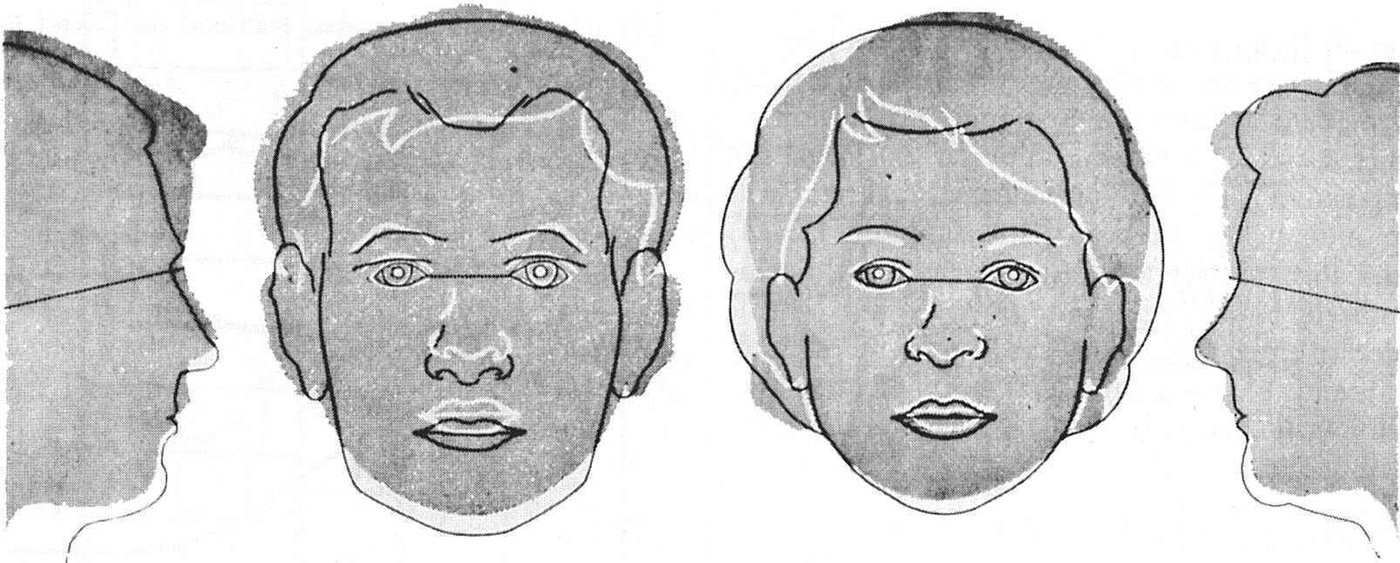
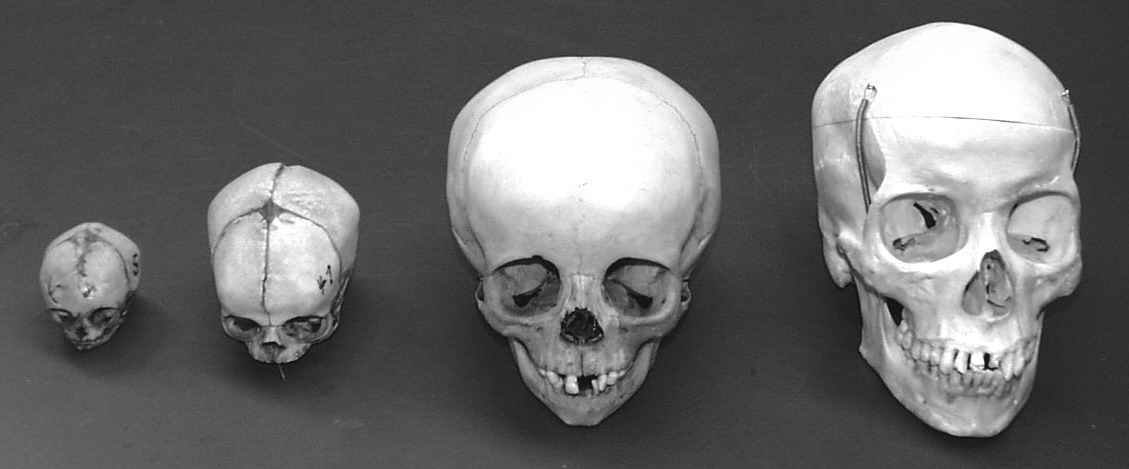
Characteristic structures like eye brows, shape of the ear and lip contours are relevant and determined early, and are definitely developed prematurely (Figure 1). Some of the bone formed characteristics (Figure 2) are even unchangeable. Whereas other features, like hairiness, vary to a greater dimension.
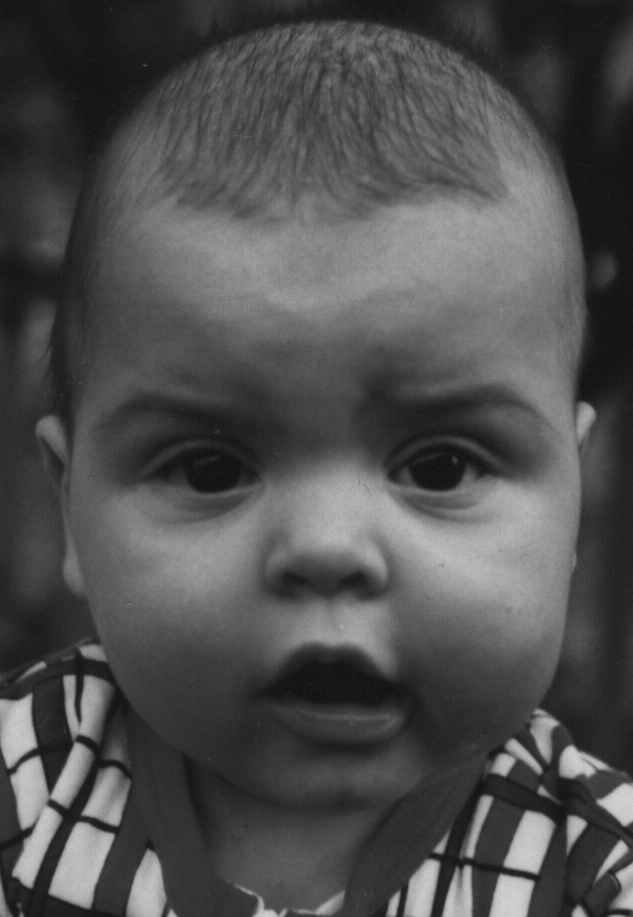
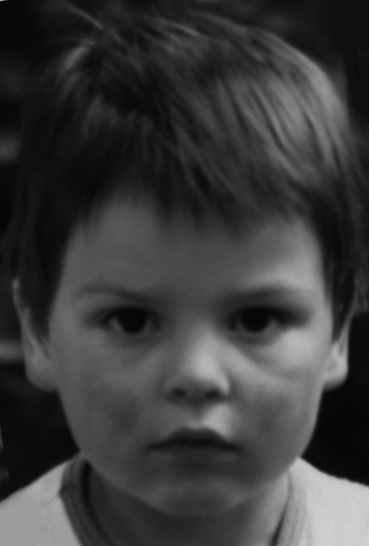
One example of a current study was selected to demonstrate the most important structures of the face that could be compared throughout childhood (Figure 3). This case shows a high conformance in the above mentioned ageless characteristics, such as the eye brows, the shape of the ears, the philtrum and the lip contours.

Discussion
The face formative characteristics are to a certain degree age dependant and, therefore, some are extremely changeable. Identification can, but must not, be totally dependant on this fact. Some, or even a lot of, individually dependant characteristics may remain from early childhood to adolescence. It is necessary to search for them, to identify them and their (typical or non-typical) variation, and list them to analyze the frequency of appearance. Characteristics that are not suitable should be eliminated to diminish the failure of false assignment.
This study will be continued and expanded to provide more data.
References
- Helmer RP, Röhricht S, Petersen D, Möhr F (1993)Assessment of the Reliability of Facial Reconstruction. In: Iscan MY, Helmer RP (ed.) Forensic analyses of the skull: craniofacial analysis, reconstruction, and identification. Cpt 17, Wiley-Liss Publications, New York, pp 229-246. ( ↑
- Martin R (1914) Lehrbuch der Anthropologie. Gustav Fischer, Jena. ( ↑
- Martin R, Saller K (ed.) (1957) Lehrbuch der Anthropologie. Bd. I, Gustav Fischer, Stuttgart. ( ↑
- Kreutz K, Verhoff MA (2002) Forensische Anthropologie. Lehmanns Media - Lob.de, Berlin. ( ↑
- Knussmann R (1996) Der Entwicklungsverlauf in Kindheit und Jugend. In: Knussmann R (ed.) Vergleichende Biologie des Menschen: Lehrbuch der Anthropologie und Humangenetik. Gustav Fischer, Stuttgart, pp 169-196. (