

Case History
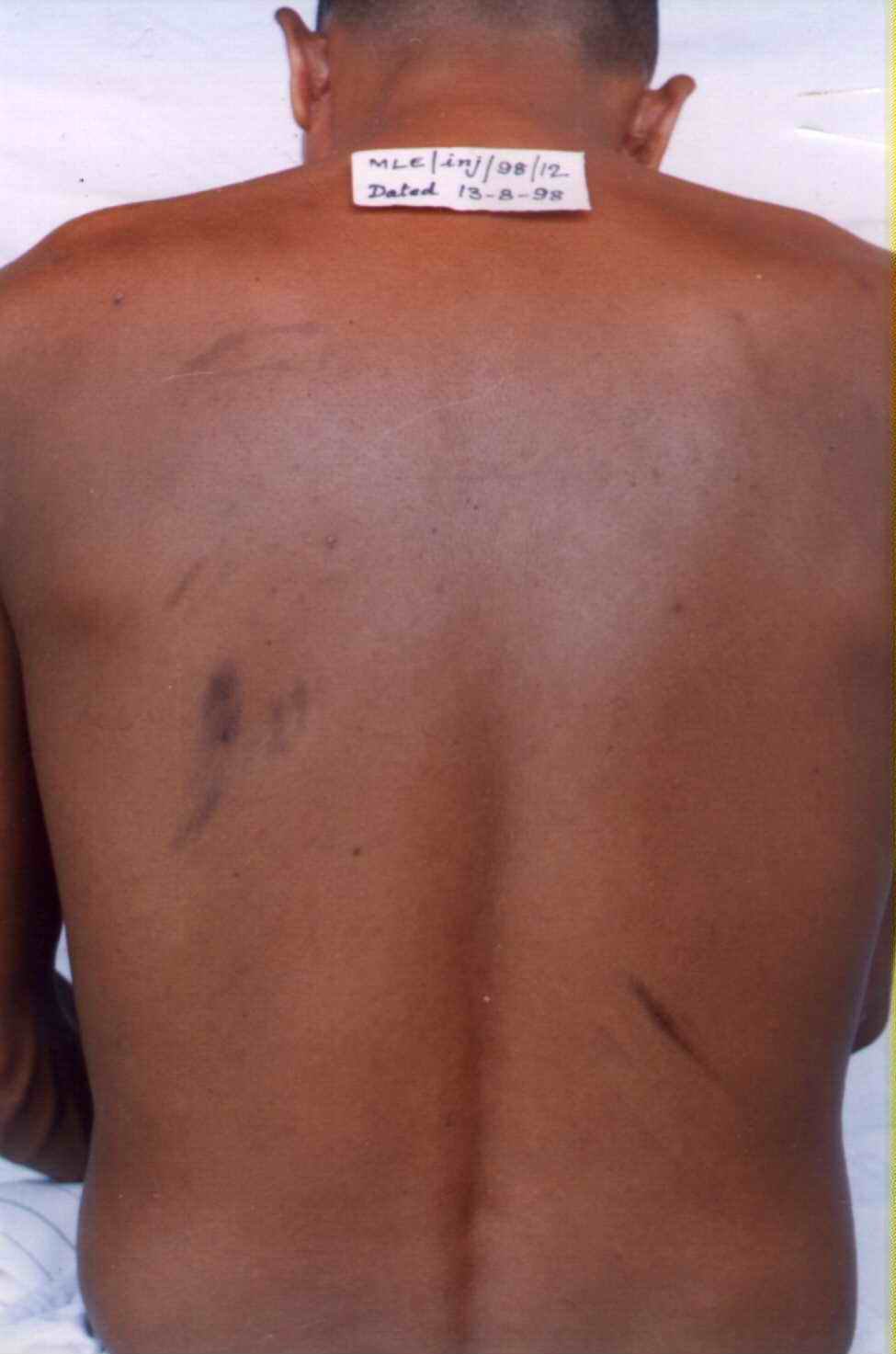
A 35 year well built male alleged that on 25.6.98 he was assaulted, by some persons with lathis (blunt wooden rods used in India for beating and other criminal activities) and axe etc. He was medico-legally examined at a peripheral hospital. The Medical Officer opined that all the injuries were caused by blunt weapons. The victim was however not satisfied with his opinion. To get a second opinion, he knocked the doors of the court. Therefore on judicial orders he was referred to the department of Forensic Medicine PGIMS, Rohtak on 13.8.98 for re-medical examination. Earlier Medicolegal Report dated 25.6.98 showed three oblique lacerated wounds on the scalp, one lacerated wound on the right knee and multiple bruises on the back with rail road pattern.
Estimating the age of bruise is a problem frequently faced by a practising medicolegist. The exercise is fraught with danger, especially as no criteria for estimation of age can be fixed. Older text books however were very specific and dogmatic on this issue. For instance the tenth edition of the classic Forensic Medicine by Sir Sydney Smith and Frederick Smith Fiddes (Published in 1955) states at page 110: The red color changes to purple or almost black very soon after the injury. In four or five days the color changes to green; in seven to ten days it becomes yellow, and gradually disappears in fourteen to fifteen days. But the color changes and ultimate disappearance of a bruise may vary over a period of from one to four weeks, depending on their severity and the constitution of the victim. Despite observations to the contrary, authors continued to repeat this dictum in their textbooks, probably because it seemed such a pity jettisoning such a "nice and neat sounding" color calender. Perhaps the first modern author to discard these ideas was Bernard Knight. In his classic Forensic Pathology, 2nd edition, 1996 he states at page 143: It is not practicable to construct an accurate calender of these color changes, as was done in older textbooks, as there are too many variables for this to be reliable. The current paper by Paliwal et al. seems to corroborate this statement by Knight. -Anil Aggrawal (Editor-in-Chief) |
|---|
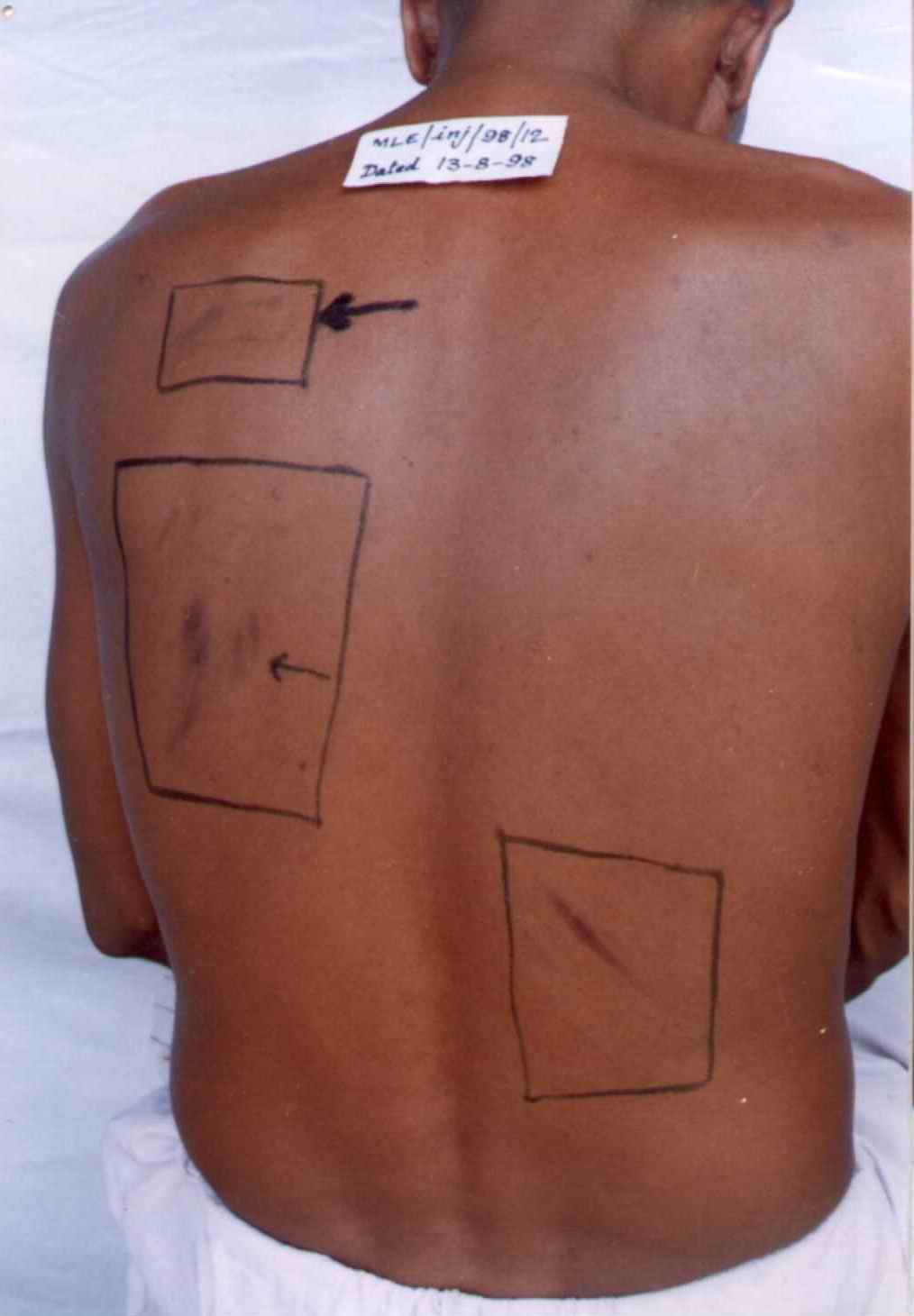
Examination on 13.8.98 revealed that the lacerated wounds were completely healed and were showing regular clear margins. So the dispute regarding the weapon of offence was sorted out on examination. But coincidentally the bruises which were noted down by Medical Officer at the peripheral hospital were still persisting with a hue of light brownish colour which clearly indicated that the site of bruise was the same as that one observed by the medical officer at the peripheral (district) hospital. So the most amazing thing was in this case that the bruises were present even after 49 days of their infliction.
Discussion
Healing of bruise usually occurs in 2 to 4 weeks' period1-5. However conditions such as far advanced senility, cachexia, very severe and multiple injuries may impair the local tissue reactions6. In ordinary circumstances, disappearance of a bruise depends upon the nature and severity of the force used, the vascularity of the part, the amount of subcutaneous tissue and fat and the looseness of the underlying cellular tissues7.
In the present case, the subject was a 35 year old male who was well built and healthy with no history of acute or chronic illnesses, cachexia or any apparent pathological conditions affecting healing of injuries or causing delayed healing. Yet he showed bruises as long as 49 days after their infliction. The bruises were however present on the back of chest and abdomen having comparatively less blood supply. This could probably be the reason for delayed healing.
Conclusion
This was an interesting case in the sense that the bruises persisted even after 7 weeks which is not mentioned in the literature. The possible reason for such a delay could be their presence at the back. Medicolegal practitioners would do well to keep this fact in mind before opining on the age of bruises.
References
- Glaister J and Rentoul E. Medical Jurisprudence and Toxicology. 12th edition. Edinburgh & London: E & S Livingstone Ltd. 1966: p 234. ↑
- Camps FE, Robinssn AE, Lucas BGB (Eds). Gradwohl's Legal Medicine; 3rd ed. Bristol: John Wright and Sons Ltd, 1976: p 265 ↑
- Polson CJ, Gee DJ and Knight B. The Essentials of Forensic Medicine, 4th Edition. London: Pergamon Press, 1985. P 104 ↑
- Reddy KSN. The Essentials of Forensic Medicine and Toxicology, 15th Edition. Hyderabad. K. Suguna Devi, Malakpet, 1995. P 141 ↑
- Knight B, Sahay V.B., Gapat SK, and Singhal ML. HWV Cox's Medical Jurisprudence and Toxicology, 6th Edition. Allahabad. The Law Book Company (P) Ltd. 1990. Pp 288-289 ↑
- Tedeschi CG, Eckert WG and Tedeschi LG. Forensic Medicine: A study in Trauma and Environmental Hazards. Vol 1, Philadelphia. W.B. Saunders Company, 1977. P 26 ↑
- Subramanyam BV (Ed). Modi's Medical Jurisprudence and Toxicology. 22nd Edition. New Delhi. Butterworths. Tripathi Pub, 1999. Pp 333-335 ↑